An Essay
The Story Behind Hello, World!
By Dale Biagio, author of Hello, World!
In April of this year I received an email from Don Chamberlin. He is the co-creator of SQL. In 1974, he and his best friend Raymond Boyce presented the language they had built together at a conference in Ann Arbor. Within thirty days, Boyce was dead. He was twenty-seven.
Chamberlin kept building.
Half a century later he read the chapter I had written about his friend.
“Draft page received. Wow, this is a moving story! Very well written. Mostly right.”
He sat down with the chapter and went through it line by line. Where I had compressed something, he expanded it. Where I had inferred, he corrected. Where I had relied on the published record, he gave me the version he had lived.
That email was one of several I received in the spring of 2026 from people who created programming languages I had spent twenty-five years using. I had written to many more than wrote back. I wanted to know if I had gotten the stories right. What came back was something more than I had asked for. They didn’t just confirm or correct. They told me their version. The way they remembered it. The parts that had been left out of the published accounts. The parts that mattered to them.
This is the story of how that book was written, and what I learned along the way about the people whose work the rest of us are standing on.
The replies
I have spent twenty-five years typing “Hello, World!” in new languages. The act became reflex. A few years ago the curiosity caught up with me. Where did those two words come from? Who chose them? Why those, and not others? The book started as a reference. Ninety languages, one page each. By the time I finished, twenty-nine of those entries had grown into longer essays. The reason was always the same. I would research a language, find the person who built it, and the person would have a story I could not fit on a page.
When the manuscript was close to finished, I made a decision. The people who built these languages were, in most cases, still alive. The careful thing was to send the chapters to them before printing. I did not expect any of them to write back. Most of them did not. These are the ones who did.
Brian Kernighan replied first. The book is named after his two words. In 1972 he sat down at Bell Labs to write a tutorial for a language called B, and typed a short program that printed “hello, world” to the terminal. He has said he barely remembers choosing the phrase. It became the most-written sentence in the history of programming. Fifty-four years later I asked him if he would write a foreword, or a sentence I could put on the cover. He wrote back with the polite no he has been giving for fifty years, telling me his decision had kept him off the back cover of “a number of fine books, which I will expect yours will be.” He closed the email saying he would look forward to reading the book when it appeared.
Alan Cooper wrote back about Visual Basic. He had read the chapter and disagreed with the irony I had landed on. He wrote twelve paragraphs explaining why. He had spent his career trying to build software for users, not programmers. He had pioneered the separation of user-facing and computer-facing design twenty years before anyone else recognized it as a discipline. He had invented blind-testing usability during development. The tool he built and called Ruby, after the daughter he never had, was conceived as a shell construction set for users. Bill Gates repurposed it as a programming environment without his knowledge. Cooper did not know he had built Visual Basic until after it shipped. The chapter I had written had inverted the irony. The corrected version reads: a man who spent his career building for users accidentally built the most important tool for programmers. I rewrote the chapter. Cooper read the rewrite and called it excellent. Then he sent one more email about Gary Kildall, who created CP/M and never got the recognition he deserved, asking that I not let his name slip into oblivion.
“A remarkably readable romp through the development of programming languages. Like me, I know you will learn more than you expected, and have fun doing it.”
Martin Richards wrote back from Cambridge about BCPL. He called the chapter on curly brackets and typelessness perfect. Then he wrote three more emails of context that no published source contains. He told me about the IBM 7094 at Project MAC where he wrote the first BCPL compiler in 1967, about the IBM golf-ball typewriter he used because the 7094’s character set could not produce the curly braces, about the choice to use $( and $) until the larger character set arrived, about why disallowing dynamic free variables was just obvious to him given typelessness and separate compilation. He apologized at the end of the email for rambling on too long. He had not rambled. He had given me sixty years of context that no textbook contains.
Simon Peyton Jones wrote back about Haskell. He went through the chapter in careful detail. He told me the type classes story I had written, which involved Phil Wadler going away from a conversation with Joe Fasel believing he understood an idea when he had not, and from that misunderstanding conceiving type classes, was new to him. He asked if I had checked it with Wadler. He told me the deeper version of the monad story: Wadler reading Eugenio Moggi’s papers on monads as mathematical logic, realizing they could become a programming construct, writing “Comprehending Monads,” and Peyton Jones realizing the same construct could solve the I/O problem in a pure functional language. They were both at Glasgow at the time. He footnoted that he has since been granted four honorary doctorates after a line in my chapter mentioning he never got the PhD. He said the doctorates were easier than a PhD would have been. He pointed me to Guy Steele as someone more knowledgeable than himself, and suggested I should write to him too.
Bjarne Stroustrup and Don Syme each replied with technical corrections without endorsements. Stroustrup objected to my chapter title for C++. The title was “The Thesis That Didn’t Compile.” He told me the thesis was good enough, it just didn’t directly relate to programming languages. He told me the C++ name came from a colleague named Rick Mascitti who had suggested it as a joke. He liked the joke. He used a smiley face when he told me. I replied that getting my code corrected by Bjarne Stroustrup would go down as my favorite ever pull request. We retitled the chapter.
Don Syme came back with a different kind of correction. I had written that almost nobody noticed F# in the early years after its release. He pushed back. Odersky and Torgerson had noticed. Luca Bolognese had given a packed keynote on async at PDC 2008 that, in his words, had the audience gasping. People who later worked on Swift and TypeScript came from the F# team.
Ian Buck wrote back about CUDA. He had compiled and tested the Hello World example. It worked. He had one suggestion: drop the cudaDeviceSynchronize call. The man who runs the foundation of a multi-trillion-dollar industry took ten minutes to do the most basic work of a code reviewer.
Here are three of the twenty-nine, condensed for the page.
Three of the stories
Grace Hopper, COBOL
In 1949 Grace Hopper joined Eckert-Mauchly, the company that built the UNIVAC. She had served in the Navy during the war, calculating ballistic trajectories on the Mark I at Harvard. She was forty-three years old. She had come to a conclusion the men around her thought was absurd. Computers, she believed, could be made to understand instructions written in something close to English.
“They told me computers could only do arithmetic. They patiently explained to me that computers could not do programs.”
She spent the next three years proving them wrong. She built the A-0, the first compiler. The machine refused to translate words into instructions for three years because everyone, including its operators, was sure the idea was impossible. When the compiler finally ran, the response from the rest of the field was that it was a parlor trick. Hopper kept building. By 1959 she was on the committee that defined COBOL, the language that would let businesses, governments, and banks write programs in syntax that read like English sentences. The world’s payroll, accounting, banking, and inventory systems were built on it.
Forty years after she retired, the world had largely forgotten her. Then, on April 4, 2020, the governor of New Jersey held a press conference. The state’s unemployment system was collapsing under pandemic claims. The system ran on COBOL. The state needed volunteers who knew the language. The governor pronounced it “Cobalt.” He meant COBOL.
By the 2020s, an estimated 95 percent of ATM transactions and 80 percent of in-person credit card swipes flowed through code written in the language Grace Hopper had spent three years convincing the world it was possible.
Raymond Boyce and Don Chamberlin, SQL
In the early 1970s, IBM’s research division in San Jose was working on a problem that mattered. Edgar Codd had published a paper in 1970 describing relational databases as a mathematical idea. The question was whether the math could be made to run.
Don Chamberlin and Raymond Boyce were both on the team. They were close friends. They had moved across the country together to work on the problem. They thought the same way and finished each other’s sentences. They built a query language they called SEQUEL, designed so that someone who was not a programmer could ask a database a question in something close to English.
In May 1974, in Ann Arbor, Michigan, they presented the paper together at the ACM SIGFIDET workshop. It was titled “SEQUEL: A Structured English Query Language.”
Within thirty days, Boyce was dead. He was twenty-seven.
Chamberlin kept working. The language they had built together became SQL, the most widely used query language in the history of computing. Every database that runs the modern world, the ones inside banks, hospitals, airlines, governments, and the application you used to read this page, runs SQL or a dialect of it. Boyce-Codd Normal Form, a foundational concept in database design, bears Boyce’s name. He is remembered, in the way mathematicians and language designers are sometimes remembered, through the structure of his work rather than through stories about him.
Half a century after the conference in Ann Arbor I sent Chamberlin the chapter I had written about his friend. He read it. He told me it was mostly right. Then he gave me the rest.
Ian Buck, CUDA
In 2003, a Stanford PhD student named Ian Buck walked into the office of NVIDIA’s chief scientist with a question. What if we stopped using graphics cards just for graphics?
The idea was not entirely new. Researchers had been exploiting GPU hardware for non-graphical computation since the early 2000s. The process was absurd. To multiply two matrices, you had to disguise the numbers as pixel colors, feed them through a rendering pipeline designed for video games, and extract the results from what the GPU thought was an image. It worked, barely.
Buck’s argument, refined through years of academic work and his Brook language prototype, was that GPUs did not need to be tricked. They needed to be designed for the task. A GPU has thousands of simple cores running in parallel. If you could give programmers direct access to those cores with a language they already knew, the speedups would be transformative.
NVIDIA hired him and gave him a team. In early 2007 they shipped CUDA, a set of extensions to C that let programmers run code across thousands of GPU threads simultaneously. The signature syntax was a triple-angle-bracket kernel launch. The book describes those angle brackets as the most commercially valuable punctuation mark ever invented.
The first adopters were scientists. Molecular dynamics, weather modeling, protein folding, financial simulation. Anywhere the same calculation needed to happen millions of times in parallel, CUDA delivered ten- to hundred-fold speedups.
Then, in 2012, a team at the University of Toronto used CUDA-accelerated GPUs to train a deep neural network called AlexNet. It won the ImageNet competition by a margin so large it ended the previous era of computer vision overnight. Everything that followed, GPT, DALL-E, autonomous vehicles, protein structure prediction, depended on neural networks trained on thousands of GPU cores in parallel. CUDA was the software layer that made it possible.
NVIDIA’s market capitalization went from roughly $7 billion in 2012 to over $4.5 trillion by early 2026. A graphics card company became the most valuable company on Earth. The triple-angle-bracket syntax became a fixture of every serious machine learning course.
What I saw
We talk about computing history as if it were a list. Dates. Names. Versions. As if the languages just appeared, fully formed, and the only thing that mattered was when.
1972 was not “Hello World.” 1972 was Brian Kernighan, sitting down at Bell Labs to write a tutorial. He chose two words almost without thinking. He has said he barely remembers picking them. He had no idea that almost every programmer who ever lived after him would type those exact words as their first conversation with a computer.
1974 was not “SQL.” 1974 was Don Chamberlin and Raymond Boyce, two best friends who had moved across the country together to throw their minds at the same problem. They presented the language they built side by side at a conference in Ann Arbor that May. It was the last thing they ever did together. Within thirty days, Boyce was dead. He was twenty-seven. Chamberlin kept building.
1979 was not “C++.” 1979 was a young Danish programmer named Bjarne Stroustrup, six months into his first job at Murray Hill, frustrated that the languages he had could not do what he needed. So he started building one that could. The name came from a colleague’s joke. He liked the joke and kept it.
1988 was not “Visual Basic.” 1988 was Alan Cooper demonstrating a tool he called Ruby to Bill Gates, planning to ship it as the shell for Windows 3, named after the daughter he never had. The tool was rejected by an internal Microsoft faction and then quietly repurposed without Cooper’s knowledge to become the most-used programming environment of the next decade. He spent his career trying to build software for users. He accidentally built the most important tool for programmers.
These are not dates. They are people. They had families, friends, fears, debts, deadlines, doubts. They built things in specific rooms during specific weeks while specific things were happening in their lives. Some of them lost the people they did the work with. Some of them never got to see what their work became. Some of them, like Gary Kildall, were quietly written out of the version of the story most of us were told.
Every one of us is standing on their shoulders. We use what they built every minute of every day, and most of the time we do not know their names.
AI might change everything from here. But we would not be here if it were not for the people in these pages. The least we can do is remember them and tell their stories.
The book
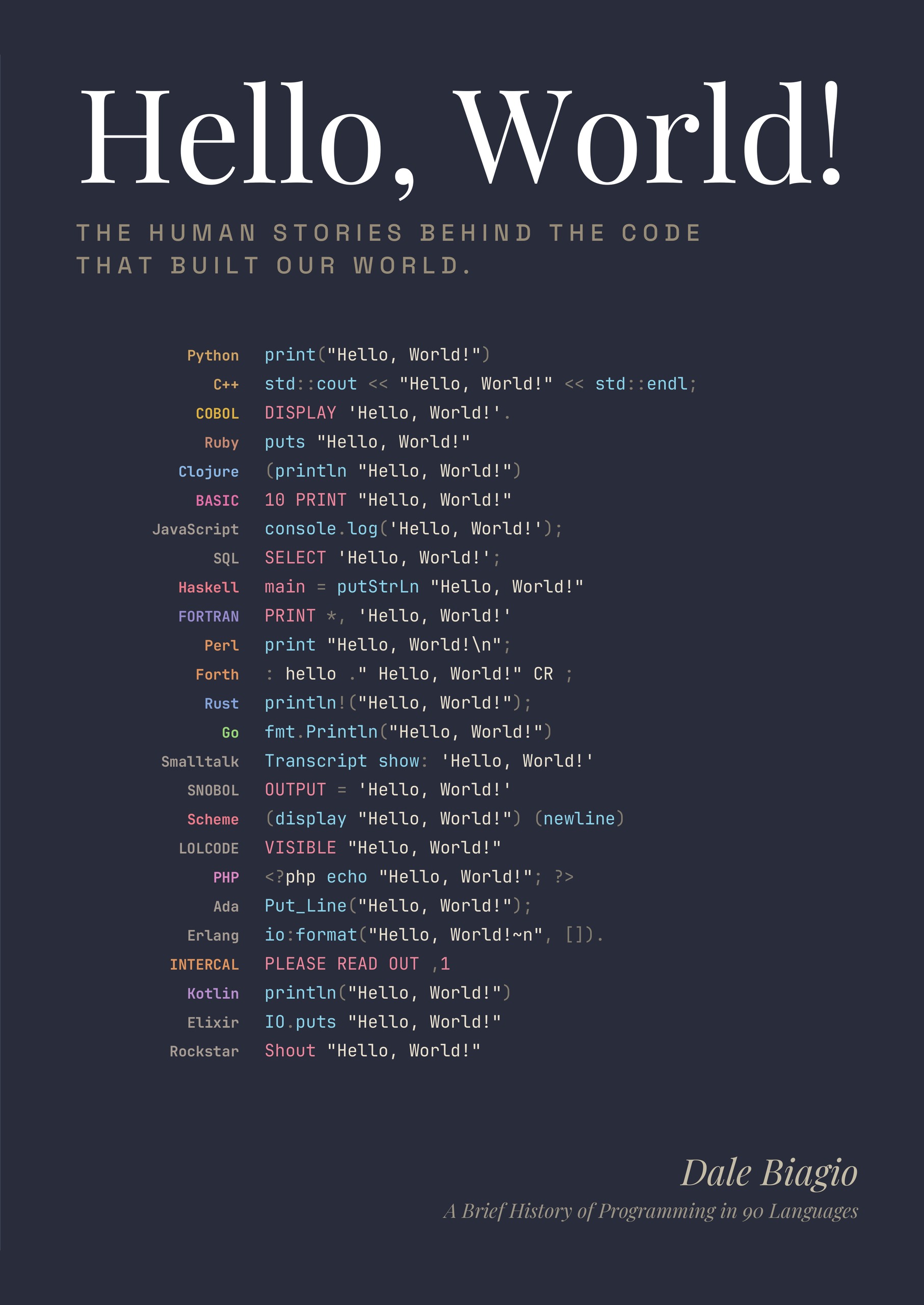
Hello, World! A Brief History of Programming in 90 Languages is two hundred and forty pages. Ninety language entries. Twenty-nine spotlight essays. Seventy-six years, from Plankalkül in 1948 to Mojo in 2024.
The book is at helloworldthebook.com.
If you want a chapter to read first, the Boyce and Chamberlin spotlight, “The Last Thing They Did Together,” is free at helloworldthebook.com/the-last-thing-they-did-together.
Dale Biagio. Alpharetta, Georgia. May 2026.